
People have been using footwear for over 30,000 years. Prior to this, humans walked and ran barefoot. Fashionable footwear that altered the foot’s shape developed over ten centuries ago. In China around that time for example, foot binding was common among women of status, stunting and deforming their feet. In medieval Europe, extremely narrow pointed shoes made of leather became a status symbol. The trendy cushioned, arch supporting running shoe took off in the 1970s. Today’s breathtakingly high heels among fashionable women, to me, are quite terrifying.
TACKIE: A South African colloquial word for a lace-up sand shoe with a rubber sole.
Tackie is also used as a slang word in South Africa for TYRE.
Many South Africans have a pair of tackies for casual wear. Many Australians have thongs. In our global village South Africans also wear flip flops; Australians wear casual sand shoes.
I have tried to find the origins of the word ‘tackie’ in South Africa. Tacky because of the sticky rubber sole? There could well have been Dutch influence (Afrikaans ‘tekkie’ – original meaning unknown). Perhaps during British colonial settlement they had been called tennis shoes. Before I was born in 1950 my parents had been wearing tackies as casual shoes for years, so their place in our culture is long and strong.
As a child I would wonder at seeing shredded tackies regularly on the side of our roads. The poorer black community would wear them out until they fell apart. Our cheerful gardener Samuel went so far as to make his own footwear from cut-up tyres. He was skilled, with the resulting style resembling today’s Birkenstock sandals.
‘Can you make me a pair of tackies from tyres Samuel?’ I once asked him. For some reason I could not understand, he found my question hilarious.
‘Why are you laughing?’ I asked.
‘Little Madam, your father and mother would not like that.’
I questioned my mother. She took time to respond.
‘You know, your Christmas present will be a new pair of tackies; how about we buy a pair for Samuel as his end-of-year gift?’
I was delighted with the idea. I had imagined my new tackies would be red and blue. Perhaps Samuel’s might be the same?
Both our pairs of new tackies turned out to be bright white. My mother had chosen our sizes well. Samuel and I would spend time in the garden – he pruned, clipped and planted, while I packed weeds and branch clippings into the wheelbarrow. We became known as the Big and Little Tackies. At day’s end our shiny tackies would be splotched with wet dirt. I’d always pull mine off before going inside, later to find Samuel had hosed down both our pairs, clean and ready for a new day.
Our feet serve us for a long time; we give them a pounding. Now living with misshapen toes, I wish I’d taken greater care of mine; I’d have ditched the platforms and stilettos of my early adulthood, and worn tackies for every occasion.
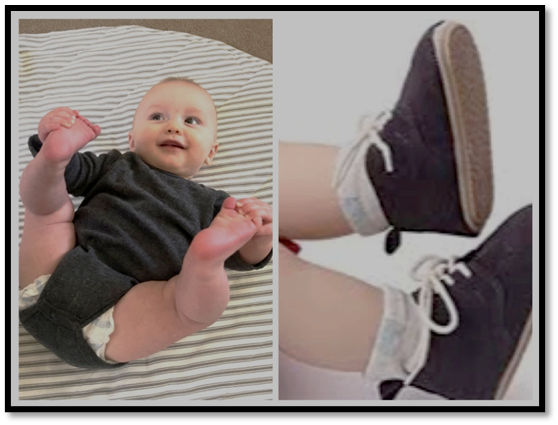
My partner’s six-month-old grandson has recently discovered his feet. They fascinate him. I look forward to buying him his first pair of tackies; his parents can choose his thongs.
 Burnside Writers Group